FINDING THE STRENGTH
TO REST
Playing the Jesus Game
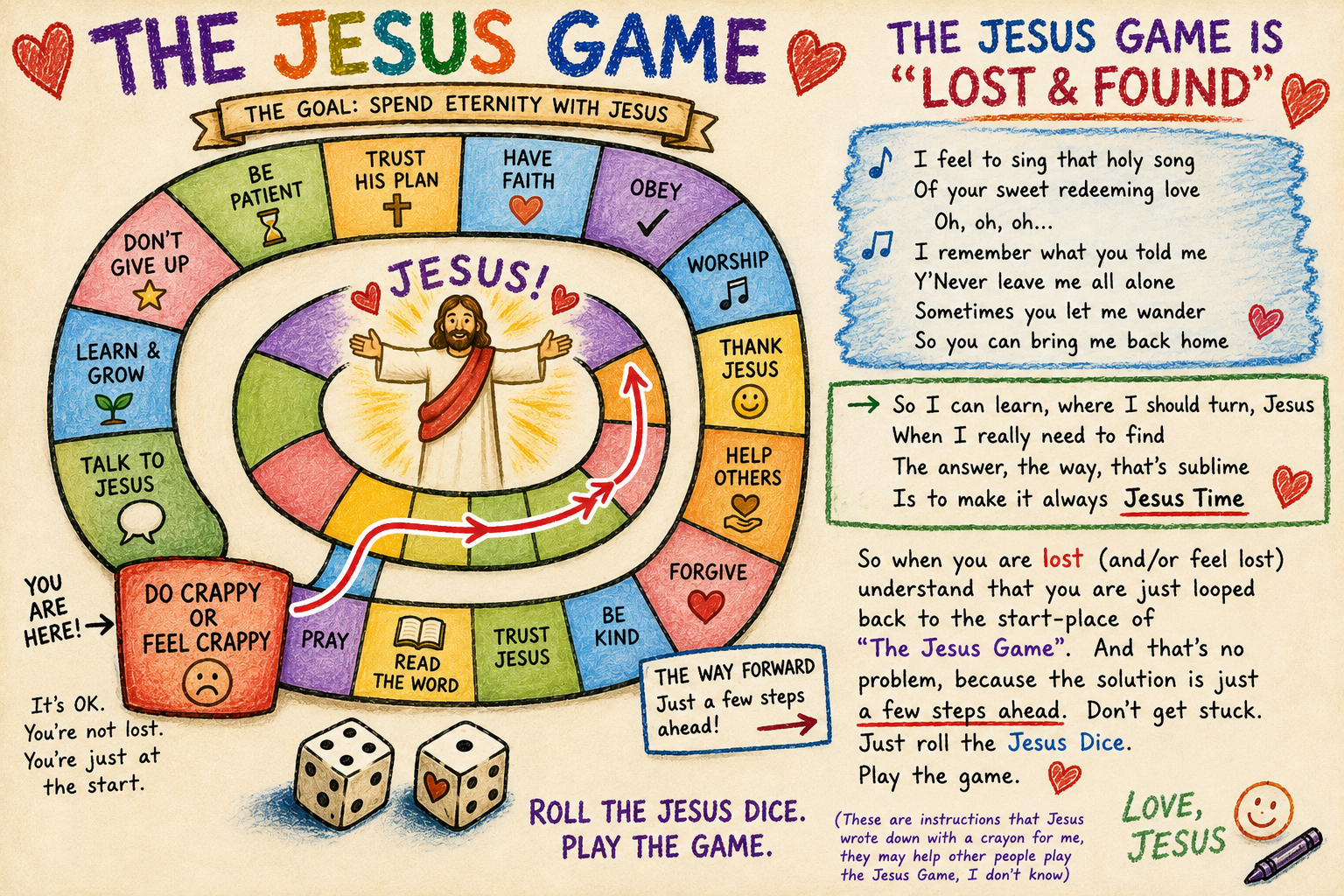
I got a Father's blessing from Jesus, in which He promised me:
ye shall walk, and not faint.”
Later, so I could make better sense of this blessing—so that I could
more fully understand what it actually (probably) means when the King
of Kings tells you that you shall run and not be weary, and gives you
other similar blessings—Jesus began to write for me a kind of
“Jesus Game Manual"
And, so that the King and I would have something fun to do together, Jesus had me help Him write this manual thing (this, I sacredly imagine/believe... I could be wrong, but I don't think so).
the rules of a very important game.
Introduction
Before we can find the rest Jesus promises, we often have to become strong enough to rest.
That sounds like a contradiction. Rest should be effortless. Yet for human beings it is often one of the hardest things we ever learn.
We are trained from childhood to compete, compare, worry, defend ourselves, keep score, and seek approval. Those habits become so natural that they feel like reality itself (they feel more obvious, less mysterious). Then Jesus comes along and invites us into something entirely different (they feel less obvious, more mysterious).
The band Boston captured a longing that nearly everyone recognizes:
That longing echoes Christ’s invitation:
But His rest does not come because the world suddenly becomes peaceful.
It comes because we begin living by a different set of rules.
One of my favorite lines from The Chosen comes after Matthew has begun following Jesus:
That sentence captures something profound.
Jesus repeatedly said:
He was not simply adjusting a few rules.
He was inviting people into an entirely different game.
Imagine you are playing basketball.
Suppose you are having an average game. You are not the leading scorer. You are not the fastest player. You are not getting much recognition.
Then one day you quietly decide to keep a different score.
Success means making one better pass than yesterday.
Success means encouraging a teammate.
Success means enjoying the game more than last week.
Success means learning one new skill.
Success means becoming a better player than the person you were yesterday—not better than everyone else.
Suddenly you are winning.
Not because everyone else is losing, but because you are measuring something different.
Would you announce your new scoring system to everyone on the court?
Probably not.
Because everyone else assumes you are all playing the same game.
Imagine playing checkers against someone who is secretly trying to lose as quickly as possible.
You would think you were defeating them.
They would think they were succeeding.
Neither of you could make sense of the other because you were operating under completely different objectives.
That is often what following Jesus looks like.
The world may think you are falling behind because you are not chasing the same trophies.
It may look as though you have stopped competing.
But you have not stopped competing.
You have simply changed scoreboards.
Instead of asking,
you begin asking,
That is not an easy transition.
It requires strength.
Strength to forgive when revenge feels natural.
Strength to trust when anxiety seems reasonable.
Strength to stop comparing yourself with others.
Strength to seek quiet obedience instead of public applause.
In other words, it takes strength to rest.
Perhaps that is why Jesus invites us to take His yoke upon us.
The rest He offers is not the absence of effort.
It is the peace that comes from no longer playing by the world’s exhausting rules.
Friendship With Jesus Was a New Game
I recognize this because I have been learning that new game myself.
When I was born again in 2015, Jesus began teaching me to evaluate my life by an entirely different rule book.
The changes were not small.
They were dramatic.
One of the greatest stretches Jesus has ever asked of me was not changing my behavior.
It was changing my relationship with Him.
Before 2015, I had no difficulty believing Jesus was God.
Or the Son of God.
Or my Savior.
Or my King.
Those beliefs fit comfortably within my Latter-day Saint upbringing.
They were part of the game I had always known.
But Jesus began inviting me into something I had never really considered.
He wanted me to know Him as my Friend.
That was different.
Not merely intellectually different.
Emotionally different.
Relationally different.
Culturally different.
Believing Jesus was my King (at least in the abstract sense) required almost no stretching.
Believing He wanted to walk beside me as a close personal friend required tremendous stretching.
In fact, it still does.
Part of that stretch came from the religious culture in which I was raised.
Years ago, Elder Bruce R. McConkie gave a talk discouraging members from thinking of Jesus as a personal friend. Whether intended that way or not, his words reflected a broader cultural emphasis that had long been, and many of us absorbed.
We readily spoke of Jesus as our Lord, our Master, and our King.
We spoke much less often about friendship.
That was the game I learned.
Today, I think the culture has been quietly changing.
I hear far more emphasis among Latter-day Saints on developing a personal relationship with Jesus Christ.
I welcome that change.
Not because Jesus changed.
But because I think many of us are finally learning to play a little more of His game.
Even so, it remains a stretch for me.
Some mornings I still find it easier to think of Him as God, and the exalted King upon His throne, than as the Friend walking beside me. My buddy.
Lord is familiar.
Friend requires faith.
The Lord fits my old religious instincts.
The Friend asks me to trust in a relationship that feels almost too intimate to believe.
Yet every time I choose to believe that Jesus truly desires my companionship—not merely my obedience—I discover a little more of the rest He promised.
Perhaps that is because friendship changes the scoreboard.
Instead of asking,
I begin asking,
That question belongs to an entirely different game.
Learning to Keep Christ’s Score
As I have reflected on this, I have begun to notice that Jesus has always invited His disciples to keep score differently.
One of the most surprising things He does throughout the scriptures is invite people to interpret painful experiences differently.
The world has one scoreboard.
Loss is defeat.
Persecution is defeat.
Sacrifice is defeat.
Humiliation is defeat.
Weakness is defeat.
Jesus quietly walks onto the court and changes the scoreboard.
That is an astonishing sentence.
He does not deny the persecution.
He changes the score.
The pain is real.
The rejection is real.
The event does not change.
The interpretation changes.
The score changes.
James teaches the same principle:
Again, the trial itself has not changed.
Only the way it is counted.
The Apostle Paul became remarkably good at this new game.
His imprisonments.
His beatings.
His shipwrecks.
His persecutions.
Rather than seeing these as evidence that God had abandoned him, Paul increasingly interpreted them as evidence that he was sharing in Christ’s work.
The martyrs learned to keep that score as well.
History remembers men and women who walked toward suffering singing.
To the world they appeared to be losing.
To themselves they believed they had already won.
Nephi understood this kind of scoring too.
Leaving Jerusalem meant leaving his home, his inheritance, his wealth, and the life he had known.
Most people would naturally score that as tragedy.
Nephi scored it differently.
He saw himself walking in the footsteps of Israel.
He was not merely becoming homeless.
He had become one of God’s covenant travelers.
He had become part of a chosen people moving through a new wilderness.
The event had not changed.
The score had.
I have begun to suspect that much of discipleship consists of learning to let Jesus keep score.
Perhaps that is one reason friendship with Jesus matters so much.
Human beings gladly sacrifice for those they love.
Parents sacrifice for children.
Soldiers sacrifice for their comrades.
Friends sacrifice for friends.
We do not usually describe those sacrifices as meaningless.
We call them honorable.
Sometimes glorious.
Love changes the scoreboard.
If Jesus is only my King, sacrifice can sometimes feel like taxation.
Duty.
Obligation.
But if He is also my Friend, sacrifice begins to feel like loyalty.
Like companionship.
Like walking beside Someone I love.
The pain may still be real.
The event may not change.
But the score does.
Perhaps that is another reason Jesus invited His disciples to become His friends.
Friends willingly play the same game.
Early Approximations
Looking back, I now realize my brother Steve and I had been practicing little approximations of this way of thinking long before I understood what Jesus was doing in my life.
We often found playful ways to step outside an inherited rule book without simply declaring war against it.
Sometimes we built a new scoreboard.
Sometimes we renamed the game.
Sometimes Sacred Clown was active.
Growing up in Latter-day Saint culture, there was a strong expectation that faithful members did not watch R-rated movies.
Whether or not it was preached from every pulpit, it was certainly preached by the culture.
Rather than argue with Hollywood’s ratings, Steve and I imagined a different rating system.
We called it the Conservative Picture Association of America.
Our reasoning was simple.
Why should our moral judgments be determined by people who did not share our values?
Why should conservative Christians surrender the right to rate films to an institution that might be antagonistic toward our religion and way of life?
Why not rate movies according to what Jesus placed in our hearts, consistent with personal revelation and the principle of religious freedom taught in Article of Faith 11?
In our minds, we still believed people should avoid movies that Jesus would not have them watch.
We had simply changed who was doing the rating.
Some films that the MPAA rated R were rated PG by the CPAA.
That allowed us to say, even to ourselves:
We simply did not believe Hollywood had the final authority to determine what counted as R-rated.
It was not merely rebellion.
It was a new rule book.
Another example was Scouting.
There was considerable prestige in becoming an Eagle Scout.
Many people pursued the Eagle Scout award because it represented the highest achievement.
Steve and I invented something even higher.
We called it the Neagle Award.
We humorously declared it the highest scouting honor on earth.
We even posthumously awarded it to nearly every President of the United States except Bill Clinton.
When someone asked,
our answer was:
Often people heard:
We felt no obligation to correct the misunderstanding.
It was part of what I now think of as the Sacred Clown—using imagination and humor to expose how much prestige depends upon the game everyone has agreed to play.
The Eagle Award was important because the culture said it was important.
The Neagle Award became important because Steve and I said it was important.
We had created a new scoreboard and declared ourselves winners.
Family Home All Evening
Family Home Evening provides another illustration.
Within Latter-day Saint culture there has rightly been a strong emphasis on families gathering together.
Traditionally, the suggested time was Monday evening, with a prayer, a lesson, an activity, a closing prayer, and treats.
That pattern has blessed countless families.
But sometimes the form quietly becomes the scoreboard.
Some families came to believe that only the formal structure counted.
A family might spend an evening talking deeply together, laughing, playing outside, watching a meaningful movie, serving one another, or simply enjoying each other’s company.
But if there was no opening prayer, formal lesson, activity, closing prayer, and treats, some people might say it did not count as Family Home Evening.
My brother Steve would sometimes tell his wife:
She would disagree because it had not followed the expected format, or because it had not happened on Monday night.
Neither person was necessarily trying to be difficult.
They were simply playing by different scoreboards.
Steve was counting the substance.
She was counting the form.
From another point of view, perhaps they had experienced a Family Home Evening approximation.
Or maybe they had enjoyed a full-on Family Home All Evening.
But this example also reveals an important limitation.
When one person begins playing by a different set of rules, it does not always count for the people around them.
It may not meet their needs.
It may even feel offensive.
Imagine again playing checkers with someone who is secretly trying to lose as fast as possible.
You believe you are playing one game.
They believe they are playing another.
That can create confusion, disappointment, or conflict.
Jesus teaches us to be peacemakers.
If changing our personal scoreboard unnecessarily creates conflict with those we love, then charity requires us to carefully consider their needs as well as our own.
A private approximation may bring peace to the person playing the new game, but it may not satisfy everyone involved.
Love is always part of Christ’s game.
That tension must be considered and resolved as faithfully as possible.
Still, I have found peace in recognizing that Jesus sometimes honors sincere approximations.
Sometimes what appears incomplete to others is exactly the stretching He asked of us.
Sometimes the old form remains useful.
Sometimes the new form is what allows us to keep moving.
Sometimes changing the game is not an act of laziness or rebellion.
Sometimes it requires enormous strength.
Why would someone go to great lengths to change the game they were playing?
Because Jesus told them to.
Perhaps that is why I love the line from The Chosen so much:
I think Jesus is still inviting His disciples into that different game.
The challenge is not simply learning its rules.
The challenge is finding the strength to keep playing them when everyone around us is still keeping score another way.
The event does not always change.
The interpretation changes.
The score changes.
And perhaps that is where His promised rest is finally found.