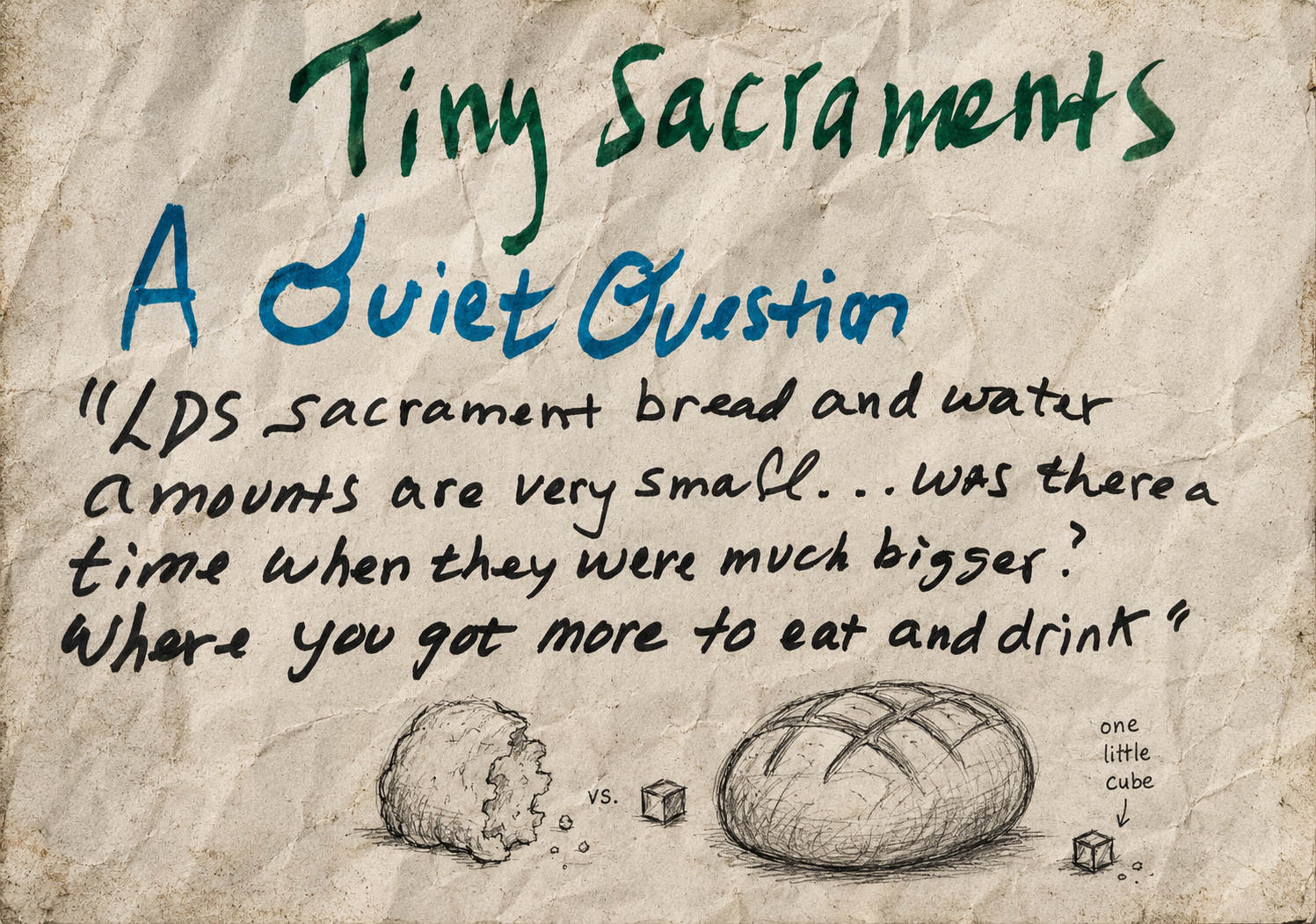
It’s a simple observation, almost offhand: the bread is tiny, the water barely a sip. You could blink and miss the physical experience of it entirely. For anyone paying attention, it raises a quiet question—was it always like this?
The answer, historically, is no. And that contrast opens up something more interesting than just a change in portion size.
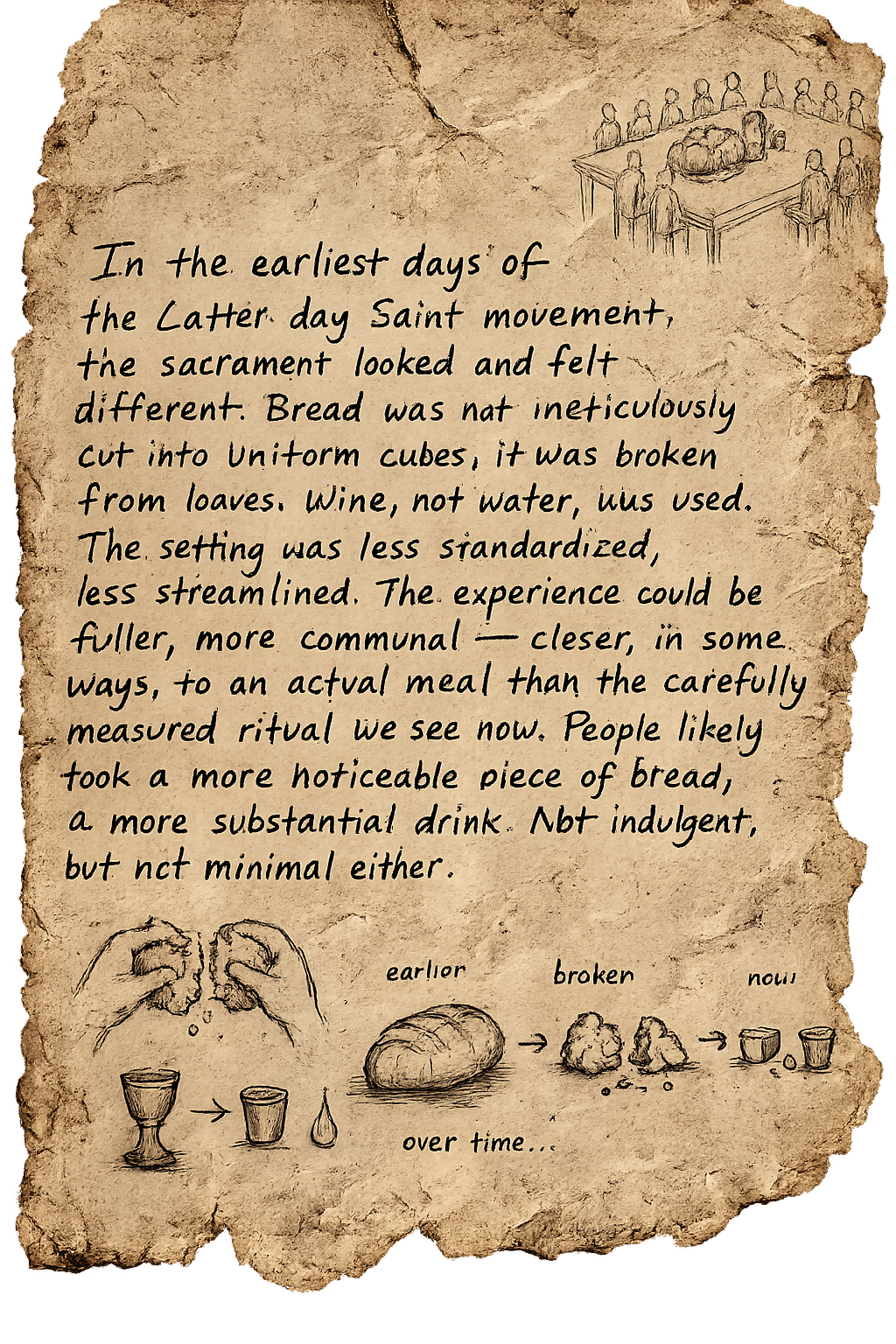
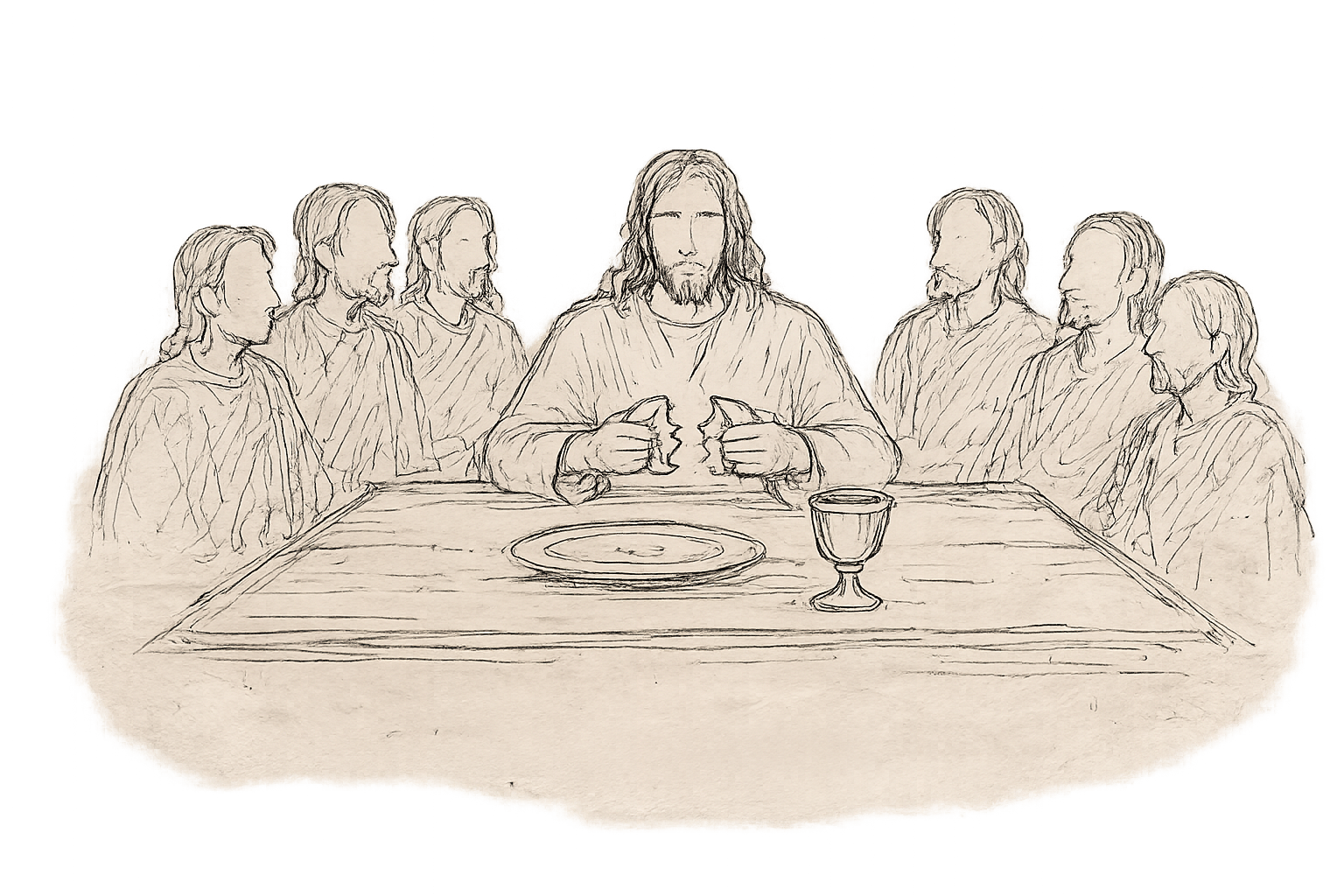
That older form carries echoes of the New Testament—the Last Supper not as a symbolic micro-gesture, but as something embedded in a shared table. Early Christianity itself blurred the line between ordinance and meal. The physical and the spiritual were not so sharply separated.
So what changed?
And maybe that’s the point.
Symbol and Experience
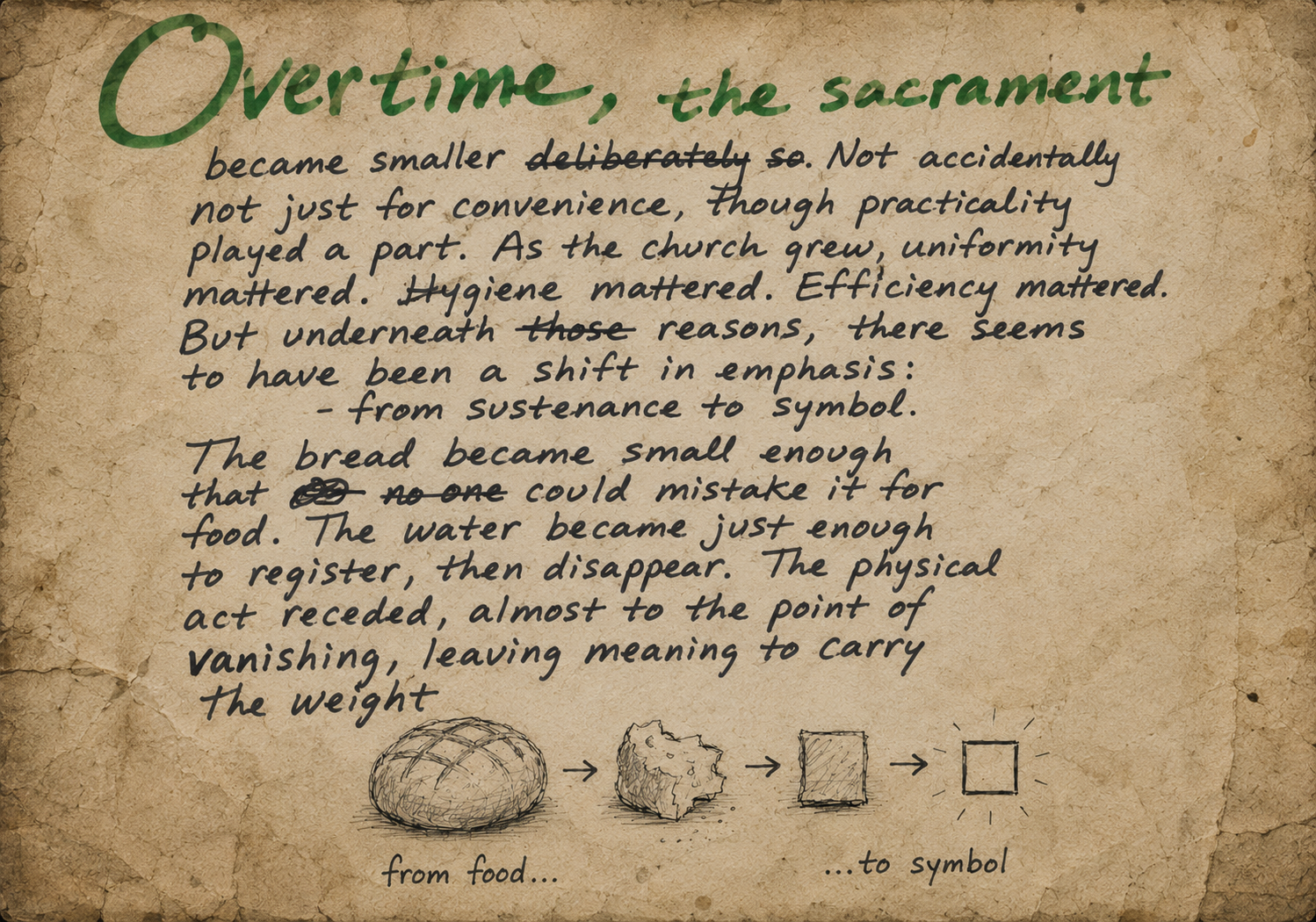
A larger portion invites a different kind of attention. It engages the body in a more obvious way. You feel it. You taste it more fully. There’s a sense, however subtle, of being fed. But a smaller portion does the opposite—it refuses to satisfy. It’s just enough to remind, not enough to fill. It directs the mind away from the physical and toward something else entirely.
In that sense, the modern sacrament is almost intentionally insufficient.
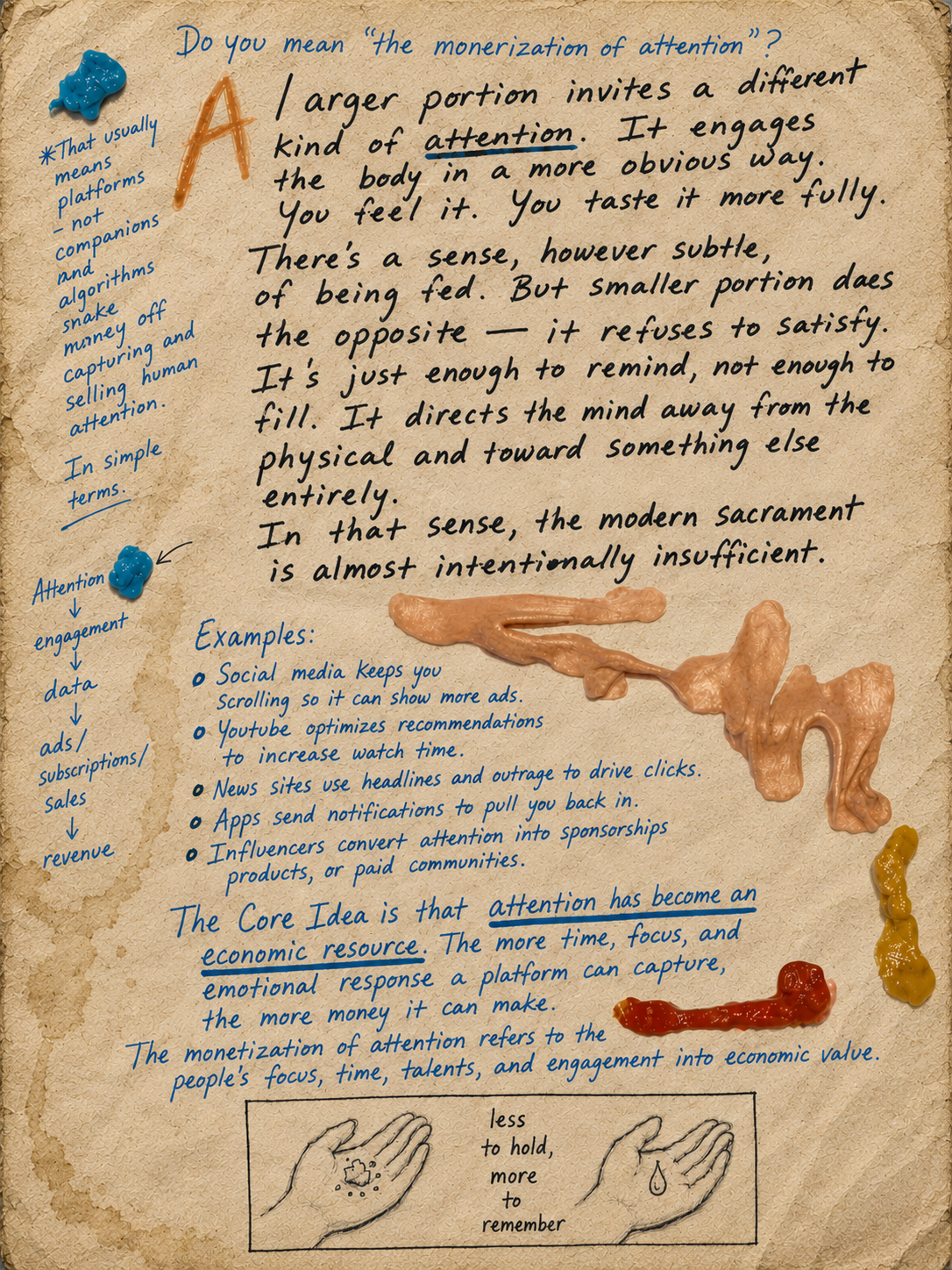
It asks for something inward to complete it.
Still, there’s something quietly compelling about the earlier practice. The idea that the ordinance once carried more physical weight suggests a different kind of spiritual experience—one where remembering Christ was not only mental or symbolic, but also tied more directly to the act of eating and drinking in a shared, tangible way.
Neither approach is inherently better. They just emphasize different things.
One says: this is a symbol—look beyond it.
The other says: this is also an experience—feel it as you partake.
Today, the smallness of the bread and water can feel almost austere. But maybe that austerity is intentional, even meaningful. It strips the ordinance down to its core, leaving behind only what cannot be reduced: memory, covenant, reflection.
Still, it’s worth remembering that it wasn’t always so slight. That once, the sacrament may have lingered a little longer on the tongue, and perhaps in that lingering, carried a different kind of presence.
Small and Simple Things
There’s a pattern hiding in plain sight.
The smaller the act, the more it seems to ask of us.
A crumb of bread. A sip of water. Not enough to nourish the body—only enough to point somewhere else. The ordinance, reduced to almost nothing physically, expands in the opposite direction spiritually. It becomes less about what is received and more about what is remembered, chosen, internalized.
That same pattern shows up elsewhere, almost playfully.
A one-page book instead of 300 pages. The message doesn’t shrink with the page count—it concentrates. There’s nowhere to hide, no excess to diffuse the meaning. You either see it or you don’t.
A “nano-marathon”—26.2 feet instead of 26.2 miles. It sounds like a joke until you realize it preserves the form while stripping away the endurance. What remains is the idea of the thing, distilled. The question shifts from Can you endure this? to Will you step forward at all?
The gospel, in its own way, keeps returning to this principle. As taught in the Book of Mormon, it is by “small and simple things” that great things are brought to pass. Not large, overwhelming displays—but quiet, almost dismissible acts that somehow carry disproportionate weight.
There’s even that ancient moment with the Brazen Serpent: people bitten, suffering, dying—and the prescribed action was simply to look. No elaborate ritual. No long journey. Just a glance of faith. And yet, as the text reflects, many did not look, “because of the easiness of the way.”
That phrase lingers. Because of the easiness.
It suggests that difficulty isn’t always the barrier. Sometimes simplicity is. We expect meaning to be proportional to effort, significance to scale with sacrifice. When something is too small, too easy, too light—we risk dismissing it.
And yet Christ’s own invitation moves in the same direction: His yoke is easy, His burden light.
Not because it is trivial, but because it is focused. Stripped down. Essential.
The sacrament, in its smallness, fits that pattern perfectly. It does almost nothing to the body—and everything depends on what the soul chooses to do with it. Like a one-page book, it can be skimmed or it can be absorbed. Like a nano-marathon, it can be stepped over or stepped into. Like the lifted serpent, it can be glanced at—or ignored.
The scale is not the test.
The willingness is.
And maybe that is the quiet invitation hidden in all these “small and simple things”: not to prove ourselves through magnitude, but to respond to what is already within reach.
Faith in the Age of Comfort
If the pattern holds—if small things are not just sufficient but intentional—then it opens the door to a more searching, and maybe uncomfortable, possibility. What if the scale of our modern religious life is not a downgrade from some former, more heroic age… but a different kind of test altogether?
It’s hard to miss the contrast. The stories we revere are full of heat and pressure: early Saints leaving everything behind, converts in England stepping into uncertainty to gather with a fledgling and controversial movement, pioneers crossing plains with no guarantee of survival, martyrs whose faith placed them in literal danger. Their devotion was forged in conditions that demanded something visible, costly, unmistakable. The environment itself pulled greatness out of them.
Our ‘comfortably numbing’ environment often does the opposite.
Ease, structure, predictability—these define much of modern life. The threats are subtler. The sacrifices are quieter. There is usually no external force requiring you to “sell all you have” or abandon everything familiar. No one is compelling you, by sheer circumstance, to prove your faith in dramatic ways. And because of that, something interesting happens: the raw material for visible, heroic Christianity isn’t automatically supplied.
So the question shifts.
Not can you be faithful when everything is on the line?
But can you be faithful when it isn’t?
What if—just as a sacred guess, an act of sacred imagination, a belief being nurtured and tested—Christ, knowing the different conditions of different eras, sends some of His followers into precisely this kind of world? Not the wilderness, not the furnace, but the age of convenience. And the question He poses is quieter, but not smaller:
Can you remember Me here?
Can you generate, from within, the kind of devotion that others had circumstances to produce?
(Will you need a crutch, to build something like an elaborate virtual/physical Jesus WORLD in the JesusVerse, not the Metaverse?)
Can you become the equivalent of a wise virgin—gathering oil deliberately, steadily, even when the night doesn’t yet feel dark? When the world is lit by a thousand substitutes—flashlights everywhere, even built into the devices in your pocket—can you still prepare a lamp you may not “need” today?
Because that is the tension: when substitutes abound, urgency fades.
And yet the invitation doesn’t.
The Tiny Sacrament as a Test
In that light, the tiny sacrament takes on new weight. Not as a diminished ordinance, but as a distilled one. You are given almost nothing—an itsy bitsy piece of bread, a tiny sip of water (not even wine, not even juice)—and asked, in effect:
Will you make something enormous out of this?
Will you take what appears to be a molehill and, through attention and intent, turn it into a mountain?
Or do you require something more dramatic—serpents that actually bite, crises that force your gaze upward, tribulations that leave no alternative but to act?
Scripture points to both possibilities. There are those who looked when all they had to do was look—and those who would not, “because of the easiness of the way.” There are warnings of future upheaval in places like Matthew 24 and the apocalyptic visions of the Book of Revelation—suggesting that, at times, the pressure will indeed return. That conditions may again demand what feels like “unprecedented action,” in the language of Russell M. Nelson.
But maybe the deeper question is not whether those moments will come.
(SIDENOTE: Perhaps, in our ease, we are now being trained for Zion— a place that, based on prophecy, will be the epitome of a modern, easy, comfortable life — where, nonetheless, the people will be able to keep themselves vigilant, deep Christians, who do not fall asleep, who embrace God with a vigor of the early Saints and martyrs).
It’s whether these moments are required.
Whether a person can arrive at that same depth—of commitment, of remembrance, of alignment with Christ—before the world forces it.
Whether you can take the smallest inputs and produce the largest possible output.
Not because you have to.
But because you choose to.
A Modern Test: Information Everywhere
And then there is one more layer—one that feels almost too current to ignore.
What if, in a pattern consistent with everything we’ve just considered, the Lord allows (or even intends) a world saturated with answers… at the very moment He most desires us to seek Him for them?
Artificial intelligence can now respond instantly, coherently, persuasively. It can summarize, suggest, guide, even comfort. It lowers the friction of knowing almost anything. In a strange way, it begins to resemble a kind of ever-present counselor—accessible, articulate, and immediate.
Which raises a quiet, unsettling question:
If answers are always available, will we still ask God for them?
Or, more precisely—will we feel the need to?
“And I said unto them: Have ye inquired of the Lord? And they said unto me: No, but we did ask ChatGPT…. for the Lord maketh no such thing known unto us.” (1 Nephi 15:8, revised)
Because here again, the pattern repeats.
When something becomes easy, abundant, ambient… it can quietly displace something deeper. Not by force, but by substitution. Not by opposition, but by convenience.
And yet, the invitation hasn’t changed: #HearHim.
Not hear something helpful.
Not hear something fast.
But hear Him.
So what if this moment—this surge of artificial intelligence, this near-frictionless access to information—is not just a technological shift, but a spiritual one?
One preparing a people for the ease of Zion.
What if it is, in its own way, another “small and simple” test?
Can you still seek revelation when information is everywhere? When the answer seems obvious. As obvious as, “No, of course Jesus wouldn’t have us literally run a 26.2feet NanoMarathon or write a literal 1-page Book.”
Can you still cultivate a relationship with God when guidance is always one prompt away?
Can you tell the difference between being informed… and being led?
Can you tell the difference between ever learning and never coming to the truth… and, well, the truth?
Knowing Where to Look
There’s an irony here that almost feels scriptural in shape.
The very tools that seem to reduce our need to look upward may, in time, expose how much we still need to. Because history—and prophecy—suggest that human systems, no matter how advanced, have a way of reaching limits. Of entangling themselves. Of producing outcomes no one fully foresaw.
It’s not hard to imagine a future—whether gradual or sudden—where complexity compounds into crisis. Where the accumulated weight of our own creations, decisions, and dependencies leads to something we cannot easily untangle. A kind of collective snafu—not necessarily dramatic at first, but deep enough that solutions become unclear, then unavailable.
And in that moment, something ancient may reawaken.
Sacrament may need to get bigger, redder, more frequent.
The same instinct that drove pioneers across plains.
The same clarity that came to early Saints when the cost was undeniable.
The same turning described by prophets like Isaiah—when, stripped of alternatives, people look to God not as one option among many, but as the only one left.
Which raises a final, piercing possibility:
What if we are being given the chance to learn that kind of turning before we are forced into it?
To choose it in a world where we could avoid it?
To develop, quietly and deliberately, the habit of going to God first—even when other voices are faster, easier, and always available?
Because if the pattern holds, then this too is part of it.
Small inputs.
Massive consequences.
A quiet choice—who you ultimately listen to—repeated over time, becoming something decisive.
Not because the world collapses.
But because, when it does—or even when it merely falters—you already know where to look.
Epilogue — The Quiet Question in an Age of Ease
Taken together, these reflections begin to converge into what might simply be called a quiet question.
Not a loud one. Not a dramatic one. But a question hidden underneath convenience, abundance, grace, automation, inheritance, and ease.
A question hiding inside the tiny sacrament itself.
Because the sacrament already foreshadows the shift.
Once, the physical experience carried more weight: larger portions, fuller participation, something closer to a meal. But over time, the physical diminished while the symbolic intensified. The bread became smaller. The water lighter. The ordinance less materially satisfying—and more spiritually demanding.
The meaning did not disappear.
The meaning migrated inward.
And perhaps modern life itself is undergoing a similar transformation.
There may be a pattern emerging in modern life that reaches far beyond religion, and perhaps even explains why this moment feels spiritually disorienting for so many people.
For most of human history, survival itself demanded meaning. Life was physically hard. Food, shelter, travel, communication, learning, craftsmanship—everything required time, labor, sacrifice, skill, and endurance. Meaning was often inseparable from exertion.
But technology keeps compressing effort.
What once took years now takes minutes. What once required communities now requires an app. What once demanded mastery can now be generated instantly by machines. Artificial intelligence, robotics, automation—all of it pushes in the same direction: making the “big” things smaller, easier, lighter, faster.
In a sense, civilization itself is becoming a kind of nano-marathon.
And perhaps that is why the deeper challenge is shifting.
The hard part may no longer be producing, surviving, calculating, building, or even knowing. Machines are increasingly doing those things for us. The hard part becomes answering a different question altogether:
What gives human life meaning when effort is no longer required to justify existence?
Or more personally:
If a robot does your job… what are you going to do?
And spiritually, the parallel becomes even sharper.
If Christ has already carried the infinite burden—if grace truly means He has done what you could never fully do yourself—then the deepest question is no longer merely, “How do I save myself?”
It becomes:
Now that heaven has been opened to you… what kind of being will you choose to become?
And perhaps this is where the whole pattern finally converges.
Because the danger of an age of ease is not merely laziness.
It is underwhelm.
When life becomes easier, smaller, faster, inherited, automated, and increasingly frictionless, the human soul risks losing not only struggle—but significance.
The sacrament quietly warned us about this long ago.
As the ordinance became physically smaller, the burden shifted onto meaning. The tiny piece of bread asks more of the imagination than the larger loaf once did. The nearly weightless sip asks more of attention than the fuller cup.
And perhaps modern life itself is becoming sacramental in this same way.
The outward exertion shrinks. The inward demand increases.
Artificial intelligence, inherited systems, inherited prosperity, inherited grace—these remove many of the obvious burdens previous generations carried. But they also remove many of the automatic conditions that once forced people toward awe, dependence, sacrifice, and dramatic faith.
Which may explain why modern people are often not overwhelmed by God.
Not because God has become smaller.
But because the conditions of modern life train attention toward surfaces, speed, efficiency, distraction, and management rather than wonder, orchestration, or participation in a living heavenly drama.
And yet Zion may require precisely the opposite kind of soul.
Not merely productive people.
Not merely informed people.
But awake people.
People capable of living in abundance without becoming spiritually numb.
People who can inhabit a world saturated with convenience, information, entertainment, and automation—and still perceive angels near them, sacrament as alignment, scripture as alive, and ordinary moments as charged with divine intention.
Perhaps this is the real test hidden beneath modern ease:
Can you remain overwhelmed by God when survival no longer forces you to be?
Can you choose sacred attention voluntarily?
Can you practice Zion before tribulation makes it unavoidable?
Because maybe the final frontier of discipleship is not suffering.
Maybe it is noticing.
The weight shifts from labor to attention.
From proving worth… to creating meaning.
From surviving… to awakening.
And that may turn out to be harder than carrying stones across a prairie.