A Prophecy I Am Beginning to Enact — One Allusion at a Time
I sense that Jesus is having me do something rather extraordinary with this new book in the Bible (JGV).
I sense He is having me prophesy.
Not merely about what He may be doing in my own life, but about what is coming—about: what other people may increasingly discover, create, and do as they learn to bring Jesus more fully into their ordinary lived experience.
I sense that a time is coming when more and more people will deliberately use their sacred imaginations to connect the teachings, symbols, ordinances, and experiences of their faith with the ordinary activities of daily life.
The Jesus Movement is on. The Jesus Revolution is starting. Jesus WORLD Building is coming forth. We'll sing and we'll shout, and we will use new tools to get MORE Jesus in our lives than we ever have before.
You might say, "We are about to be born again." You wouldn't be wrong.
We (they) will discover ways to remember sacred things through their movements, their surroundings, their work, their relationships, their music, their technologies, and their routines.
And I suspect that, for Latter-day Saints in particular, this may include increasingly imaginative and meaningful ways of carrying the lessons and symbolism of the temple into everyday life—while continuing to respect the sacredness and privacy of temple worship.
I envision people increasingly transforming their ordinary days into living networks of sacred allusion.
I am not claiming to know exactly how or when this will happen. I am describing something I sense may be coming, something I feel invited to explore, and something whose fruits I intend to examine as it unfolds.
But here is the especially interesting part:
I sense Jesus is not merely having me write about this possible future. I sense He is inviting me to begin enacting it.
One allusion at a time.
One morning stretch.
One raised arm.
One imagined mast.
One sail catching the wind of the Spirit.
One remembrance of Christopher Columbus being wrought upon.
One private remembrance of the temple.
One more opportunity to remember Jesus.
And then another.
And another.
This is what particularly intrigues me about the relationship between prophecy and enactment.
What if some prophecies are not merely announcements about what will happen someday?
What if some are also invitations to begin living toward the future they describe?
What if, in the process of imagining and describing what people might someday do, I am also discovering what I can begin doing right now?
“Lead by example and prophesy by example.”
I think of Revelation 19:10:
"For the testimony of Jesus is the spirit of prophecy."
And I think of Joel 2:28, with its extraordinary promise concerning the outpouring of the Spirit, visions, and dreams.
I wonder whether the future may include more people discovering personal, creative, embodied ways of responding to what they understand the Spirit to be teaching them.
Perhaps some of them will write about it.
Perhaps some will sing about it.
Perhaps some will build environments around it.
Perhaps some will use artificial intelligence to help them discover and organize meaningful associations.
And perhaps some will simply raise an arm while stretching in bed—and remember Jesus.
I do not know whether others will follow this particular path. I am not suggesting that everyone should construct a Jesus-Greg WORLD of their own, or that my interpretations carry authority for anyone else.
But I do wonder whether my little experiment might be an early illustration of something much more widespread.
I am imagining a possible future, describing it, and beginning to rehearse it in the present.
That is what I mean when I say I sense Jesus is having me enact a prophecy.
And the enactment does not have to begin with something spectacular.
It can begin with something as ordinary as raising my arm.
Mr. Miyagi had Daniel wax a car.
Perhaps I am only beginning to understand what all my own waxing, painting, stretching, opening, folding, singing, and remembering might be preparing me to learn.
So this thought piece is more than a description of an interesting personal mnemonic technique.
It is my attempt to put into words a possible future of sacred living—and to document my own small experiment in bringing that future into the present.
A prophecy I sense I am being invited to explore.
A future I am beginning to rehearse.
An opera I am learning to inhabit.
One allusion at a time.
And that brings me to the two tools at the heart of this experiment: sacred imagination and allusion.
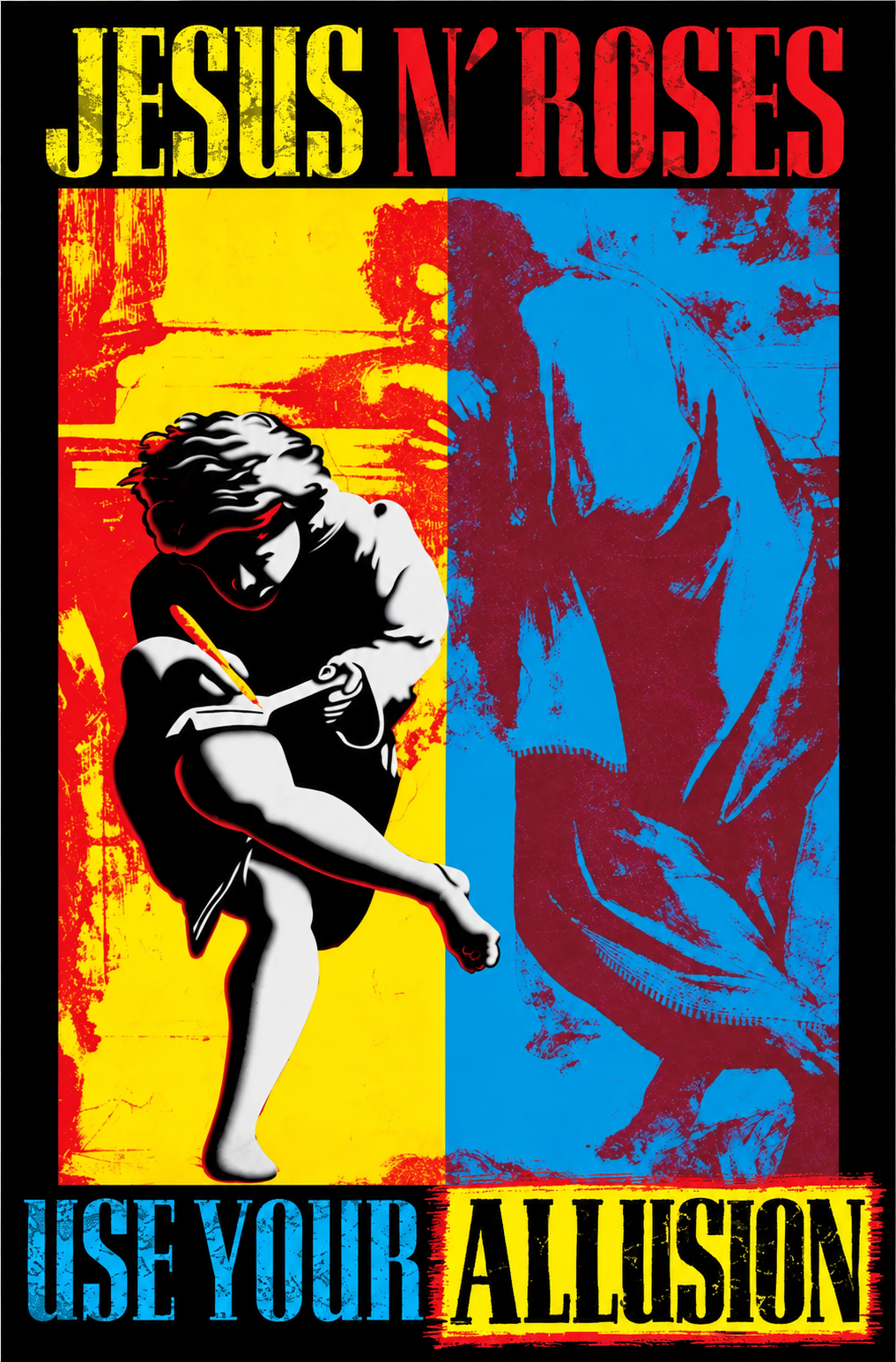
Introduction: Use Your Sacred Imagination. Use Your Allusion.
I have been experimenting for years with what I call sacred imagination—deliberately using my imagination to make Jesus, scripture, and sacred things increasingly present in my ordinary lived experience.
I am not suggesting that imagining something makes it objectively true. Rather, I am exploring what happens when I take seriously what I already believe and deliberately organize my attention, surroundings, memories, and actions around those beliefs.
In my Jesus-Greg WORLD, imagination is not merely an escape from reality. It is a tool for engaging reality more intentionally.
And increasingly, I am discovering another tool that works beautifully alongside sacred imagination:
ALLUSION.
An allusion is an indirect reference to another person, event, story, scripture, song, symbol, or idea. It points beyond itself. Something ordinary becomes a doorway into something larger.
Allusions are everywhere in literature, art, music, and scripture. But why leave them on the page?
Why not build them into the movements of an ordinary day?
Why not use a stretch, a doorway, a piece of clothing, a song, a folded piece of paper, a hand gesture, or even a household chore to recall something sacred?
Sacred imagination supplies the meaningful connections. Allusion gives those connections a physical, visible, audible, or otherwise memorable expression.
Together, they can transform an ordinary activity into a prompt for remembering.
Sacred imagination helps me construct the connection. Allusion helps me carry that connection into lived experience.
And repetition helps me remember it.
This is not merely a matter of decorating my life with religious symbolism. I am interested in what happens when sacred meanings become so thoroughly associated with ordinary activities that those activities begin prompting remembrance almost automatically.
I want to remember Jesus more often.
I want to recognize more opportunities to pray, ponder, give thanks, repent, serve, and follow Him.
I want to experiment with what it might mean to pray always.
I want MORE Jesus in my ordinary day.
And now I am beginning to wonder whether the Lord has been preparing me for something much larger than I previously understood—something that connects directly to what I am calling Future Jesus World.
Future Jesus World is not merely a distant imagined society or a technological fantasy. It may be a way of describing what happens when sacred imagination, embodied remembrance, daily discipleship, community, art, and technology begin working together to make the presence and teachings of Jesus more available within ordinary life.
It seems likely to me that, anciently, people who went to the temple found ways to express what they were learning there—and what was being symbolized there—through the rest of their daily lives. Temple meanings may have been carried into family relationships, work, clothing, architecture, storytelling, gestures, meals, songs, and patterns of conduct. The temple was not necessarily experienced as an isolated event disconnected from ordinary existence. Its symbols and teachings could become part of the imaginative and practical language through which people understood the world.
I think something like that may happen again.
Perhaps the future will bring a renewed blending of temple learning, daily life, sacred imagination, and embodied allusion. Artificial intelligence and other technologies may assist us in this complex work—not by replacing worship or revelation, and not by making sacred things trivial, but by helping us discover, remember, organize, personalize, and practice meaningful connections.
Technology could help identify patterns in our routines, suggest reminders, generate music or images, adapt environments, preserve personal associations, and create forms of allusion that fit the requirements of everyday life. It might help sacred meanings become more accessible, more memorable, and more naturally integrated into the activities we already perform.
If used wisely, these tools could complement and even significantly enhance the ways people express what they are learning from scripture, temple worship, and discipleship. They could help us construct a daily world in which ordinary actions carry layered reminders of Jesus—reminders that are not merely decorative, but formative.
This may be one of the beginnings of Future Jesus World: not the abandonment of ordinary life, but the gradual transformation of ordinary life into a richer field of remembrance, meaning, and response.
Something may have been happening right under my nose.
Or perhaps, more accurately, right under my raised arm.
1. A Marvelous Work and a Wonder — Wax On, Wax Off
I sense that Jesus may be undertaking a marvelous work and a wonder in my life—one that, in retrospect, may have been underway for years without my fully recognizing what was being constructed.
I compare this to Mr. Miyagi teaching Daniel karate in The Karate Kid.
Daniel thought he was waxing cars, painting fences, and sanding floors. Only later did he discover that these ordinary, repetitive physical actions had been training his body in the movements of karate.
I wonder whether something analogous has been happening in my Jesus-Greg WORLD.
Consider my morning stretch.
I raise my arm.
But increasingly, this is no longer merely a stretch.
My arm becomes a mast. The mast raises a sail. The sail catches the wind. The wind becomes an allusion to the Spirit. The Spirit reminds me of Christopher Columbus, who, according to 1 Nephi 13:12, was "wrought upon" by the Spirit of God.
And that brings me back to myself:
I, too, can be wrought upon. I can move as I am moved upon.
But there is another layer.
The same physical gesture simultaneously alludes to a sacred action within the Latter-day Saint temple—one whose particulars I choose not to disclose publicly.
Thus, a single ordinary physical movement becomes a meeting place for multiple sacred associations.
RAISE MY ARM
An ordinary morning stretch.
- Mast and sail: Columbus, wind, voyage.
- Spirit: Being wrought upon.
- Sacred temple action: A private, embodied allusion.
- Daily discipleship: Remembering to follow Jesus.
All of these associations converge in a single movement within my Jesus Groundhog Day.
An ordinary day increasingly inhabited by sacred meaning.
2. The Larger Possibility I Am Beginning to Envision
And here is what particularly interests me:
I suspect this morning stretch may be only one small example of a much larger pattern.
What if every significant element of the temple could eventually find one or more allusive expressions within my ordinary lived day?
Not by reproducing the temple ceremony publicly, nor by replacing temple worship, but by constructing a daily life saturated with reminders of what the temple means to me.
My Jesus Groundhog Day—my daily opera—would increasingly become a network of embodied allusions to the temple.
Some associations might be visual. Others physical, musical, verbal, spatial, or interpersonal.
Some temple elements might have multiple representations distributed throughout the day. And a single daily action might allude to several temple elements simultaneously.
I would not necessarily need to stop what I am doing and consciously rehearse an elaborate interpretation. With repetition, the association could become increasingly immediate.
My body could begin remembering what my mind has deliberately taught it to associate.
In that sense, my ordinary day would become something like a distributed temple memory palace.
And perhaps this is one place where Future Jesus World begins to take shape: through a growing network of humanly meaningful associations, supported by tools that help us notice, refine, and sustain them without displacing the personal work of worship and discipleship.
3. Five Things I Find Especially Interesting
First: Moving from remembering scripture to physically enacting reminders of scripture
This is a meaningful distinction.
I am not merely reading about Columbus being wrought upon. I am developing a physical gesture that helps me remember and explore what being wrought upon means in my own life.
The gesture is not the scripture. Nor is it evidence that my experience is identical to Columbus's.
It is a deliberately constructed reminder that invites me to consider the scripture personally.
Second: The Miyagi analogy and the importance of repetition
Miyagi's movements acquired significance through practice.
Similarly, my associations may become more accessible through repeated use. I do not have to establish every connection intellectually each morning.
The physical action can become the prompt.
And the prompt can become increasingly familiar.
Eventually, I may discover that some of these gestures remind me of sacred things before I consciously decide to remember them.
The ordinary action becomes a rehearsal.
Third: Developing a personal language of allusion
A stretch, a doorway, a piece of clothing, a song, a folded piece of paper, or a physical gesture can become part of a vocabulary whose meanings are layered and interconnected.
This is particularly interesting sociologically.
The same movement can be interpreted very differently by an observer and by the person performing it.
What looks like stretching to an outsider may be, for me, a moment of scripture study, recollection, prayer, and temple remembrance.
And there is no requirement that everyone else recognize the allusion.
Some of my allusions may be public. Others may be shared with family or friends. Still others may remain entirely private.
An allusion can carry meaning even when its meaning is invisible to an observer.
Indeed, that may be one of its most useful characteristics.
I can be doing something perfectly ordinary while privately remembering something extraordinarily important to me.
Fourth: The temple becomes not merely somewhere I visit, but something I repeatedly remember through ordinary life
This is a potentially powerful development in my longstanding experiment with making religious belief experientially present.
Rather than restricting sacred recollection to a particular building or scheduled worship period, I am experimenting with ways to carry its meanings into everyday activities.
I still go to the temple.
I still regard the temple itself as sacred.
But I am exploring how the meanings I associate with temple worship can accompany me when I leave the building.
A temple experience may last a relatively short time.
Its remembrance can continue throughout the day.
And throughout a lifetime.
Perhaps this is also what happened in earlier times: people entered sacred spaces, received teachings and symbols, and then found ways—consciously or unconsciously—to let those meanings shape the rest of their lives.
Fifth: This is a hypothesis I can actually explore
I sense Jesus is directing this process. I cannot independently demonstrate that divine causation, but I can examine the experience and its fruits over time.
For example:
Do these allusions help me become more attentive, loving, prayerful, patient, and willing to serve?
Do they deepen my temple worship rather than merely multiply associations?
Do they help me remember and follow Jesus?
Do the technologies I use support genuine remembrance and discipleship, or do they merely produce novelty?
Do they fit the requirements of everyday life in ways that make goodness more practicable rather than more complicated?
Those are meaningful ways to evaluate the practice.
My goal is not to accumulate the largest possible collection of clever symbols.
My goal is to become more responsive to Jesus.
MORE Jesus. More remembrance. More discipleship. More reality.
4. The Opera May Be Becoming a Choreography
Until now, much of my Jesus-Greg WORLD has involved objects, rooms, music, images, stories, and symbolic associations.
But here something additional is emerging:
My body itself becomes part of the symbolic architecture.
Not just the Jesus Pillow, Jesus Shower, Jesus Door, or Jesus Table.
My arms. My hands. My posture. My movements.
The opera is no longer merely something I stage around myself.
It is something I physically perform as I live.
And that makes my choice of the word allusion especially apt.
An allusion need not be a literal reenactment. It can be a subtle gesture that points toward something much larger.
I might eventually have hundreds of these embodied allusions woven into an ordinary day—some consciously designed, others discovered through experience.
And they could become what I might call:
THE CHOREOGRAPHY OF REMEMBRANCE.
The larger possibility I am contemplating is this:
What if I could spend the rest of my life learning to inhabit the temple—not by remaining inside its walls, but by allowing its sacred meanings to find expression throughout my ordinary day?
And what if the ordinary movements of that day—my own wax-on, wax-off—became a lifelong rehearsal of remembering Jesus?
The temple as a sacred source.
The lived day as an ever-expanding network of allusions.
Technology as a possible assistant in discovering, arranging, and sustaining those allusions.
And the opera as my way of bringing those associations into practice.
This may be part of the promise of Future Jesus World: a world in which tools, environments, and intelligent systems help people carry sacred learning into the texture of daily life, while the essential work of choosing, loving, serving, and following Jesus remains deeply human.
5. Another Story Must Begin
There is something wonderfully amusing to me about the possibility that I have been rehearsing for years without knowing the full extent of what I was rehearsing.
Daniel was painting a fence.
I have been stretching, showering, dressing, opening doors, eating bread, listening to music, moving my hands, and going about the ordinary business of being alive.
And I increasingly wonder whether I am only beginning to discover the meanings that these activities can carry.
I do not know how far this experiment will go.
I do not know whether every element of the temple will eventually find its way into my daily choreography.
But I am intrigued by the possibility.
And I am especially intrigued by the idea that the learning process itself may be part of the gift.
Perhaps I will spend years discovering new connections.
Perhaps I will revise or abandon some associations and develop others.
Perhaps artificial intelligence, augmented environments, wearable devices, adaptive music, and other technologies will help people discover connections that would otherwise remain hidden—not by dictating what sacred things mean, but by assisting us in remembering what we have prayerfully chosen to mean by them.
Perhaps these tools will help us fit sacred allusion into the actual demands of work, family, health, communication, travel, and rest.
Perhaps they will help us create forms of remembrance that complement everyday life and, at their best, significantly enhance our ability to live what we are learning.
Perhaps an allusion I create tomorrow will remind me of something I do not fully appreciate until years later.
That would be very Miyagi.
And it would fit beautifully into my opera:
Heaven Can't Wait — Born Again — Another Story Must Begin.
Every morning, another performance.
Every morning, another opportunity to remember.
Every morning, another opportunity to become more attentive to the Spirit.
I raise my arm.
I imagine the mast.
I imagine the sail.
I remember Columbus.
I remember being wrought upon.
I remember the temple.
I remember Jesus.
And then I get out of bed and go about the ordinary business of living my life.
Except that perhaps, increasingly, it is not quite so ordinary.
Perhaps the future of sacred living will involve learning how to carry temple meanings into daily life with greater intentionality, creativity, and assistance.
Perhaps Future Jesus World will not arrive all at once.
Perhaps it will emerge through countless small acts of remembrance—through gestures, objects, stories, technologies, relationships, and habits that help ordinary people recognize Jesus more often in the midst of ordinary life.
USE YOUR SACRED IMAGINATION.
USE YOUR ALLUSION.
#HearHim