Additional Reading – Serenity Prayer(ish)
just something I need to remember to do:REST (easy & active)
&
EXPERIMENT (easy & wild)
Jesus Has Full(ish) Control Of My Life
Scriptures have layers of meaning. One reason Christ’s yoke is easy and His burden is light is because of the underlying (but often missed, because it is an uncomfortable truth) constraint of life pointed to in the Serenity Prayer: “to accept the things I cannot change.” The fact is that much of life is determined by things we have no control over—i.e., Jesus has (and does) orchestrate such a significant amount of our life experience. A big part of receiving His rest is accepting (and making the best of) that which we cannot change. The gift of the Stoic (à la Marcus Aurelius). Learning to suffer well (1 Corinthians 13… charity suffereth long…), and so on.
This thread of thought shows up across Christian scripture, Stoic philosophy, and lived experience. At the heart of it is a paradox: the burden becomes lighter when we stop trying to carry what was never ours to carry.
When Christ says, “My yoke is easy, and my burden is light” in Matthew 11:30, it does not mean life becomes easy in circumstances; it means the inner resistance changes. The heaviness we often feel is not just from events themselves, but from fighting reality: wishing something were not happening, trying to control what cannot be controlled, resisting limitations, loss, or uncertainty. That is where the connection to the Serenity Prayer lands powerfully: “accept the things I cannot change.”
That kind of acceptance is not passive resignation; it is alignment with reality, which frees up energy for what can be chosen: response, meaning, love, endurance. Where this meets Christ’s rest is in a shift in agency: not “I must manage everything,” but “I will be faithful with what is mine, and trust God with what is not.” That is very close to what Marcus Aurelius taught: focus only on what is within your control—your judgments, choices, and actions.
And yet Christianity adds something Stoicism does not fully include: a relational trust, that what we cannot control is not random, but held within divine purpose. Learning to suffer well is key here. Charity, or love, suffereth long, or more literally, is long-suffering. That suggests suffering is not optional, but the way we suffer can be transformed. To suffer well might mean not collapsing into bitterness, not denying pain, but carrying it with patience, humility, and even compassion. Almost like this: pain is inevitable, but resentment is optional.
The uncomfortable truth named here is that much of life is shaped by forces outside our control, but paradoxically, accepting that limitation can feel like relief: you do not have to solve everything, you do not have to control outcomes, you are allowed to be finite.
A way to frame it is this: Stoicism says accept what you cannot control; Christianity says trust the One who controls what you cannot; charity, or love, says endure what comes with grace. And where they meet is here: freedom comes not from controlling life, but from consenting to reality with faith and love.
My Jesus WORLD (an orchestrated reality)
What was just framed can be combined with the following: Jesus as the Builder of Every Jesus-World. Every person already has a Jesus-world, a personal universe being shaped, orchestrated, sustained, and subtly curated by Jesus Himself.
Jesus has revealed that profound truth to me that I might have a very coherent synthesis: that I might see Christ’s yoke, the Serenity Prayer, Stoic acceptance, and the idea of a Jesus-world all into one unified lens.
Reality is largely given. Agency is real but bounded. Peace comes from accepting the given and aligning my agency with God’s purposes inside it.
That is not a small idea; it is (for me) an important, full(er) worldview.
Much of the sacred clown act and art (I do/ Jesus! has! me! do!) explores and reinforces this tension: my embracing and enjoying the ease of 5th-grade art at age 62, my writing one-page books (and actually listing them on my resume, as if), my starting worldwide projects like Jesus TV on a shoestring, and so on, and so on, and so forth, all demonstrating again and again (to me, from Jesus) that, indeed, His yoke is easy, easy, easy and His burden is light, light, light; miracles are just a belief away, as are multitudes of ministering angels, and Spirit Prisoners who are tuned into Jesus’ Jesus TV (aka Facebook Live Jesus Street Preaching)—even while it may appear to me like I am peaching to the “crickets”.
At the heart of this is playful, a little subversive, modus operandi [ˈmɔ.dʊs ɔ.pɛˈran.dɪ] that Jesus leads me to is designed (by Jesus) to have me lean towards embodying the idea rather than just explaining it.
—————-
I find there is something genuinely insightful in using the sacred clown mode (that Jesus has gifted me with) to explore this tension: small, almost childlike actions, like 5th-grade art and one-page books, set against vast, cosmic framing, like Jesus-worlds, angels, and global projects. That contrast itself teaches the point (to me): the scale of the act is not what carries the power. Why it works: it breaks ego, releases pressure, and invites trust. At least for me.
Experiment (to keep free, grounded)
DANGER DANGER DANGER.
Believing this way (I do)—–that Jesus is so so so up in my business, that I don’t have control of my life, etc.—– can be dangerous (AND IT IS!).
But believing what anti-Christ cult, cult, (cult)ure teaches me to (normally) believe can be (EVEN MORE DANGEROUS).
I’ll take my chances.
Yes, it is dangerous:
>>> I get it….. If everything is framed as divinely amplified regardless of observable impact, it becomes hard to evaluate what’s actually happening, refine my work, and stay connected to other people’s experience.
>>> I get it….. If I am not careful I can unintentionally replace agency with assumption.
But the Jesus framework Jesus and I are building out (together) is very balanced: God builds most of the world, I act within a real zone of responsibility. (THAT’S THE BELIEF!)
But again, danger!!!…. if everything is already “miraculous by default,” that zone can shrink too much.
How does Jesus have me handle that philosophical/moral cliff?
EXPERIMENT EXPERIMENT EXPERIMENT.
Jesus has me mitigate the stated risks by having me be SUPER EXPERIMENTAL.
Part of how I resolve the danger of wild, bold beliefs is through Alma 32—“experiment upon the word.”
I’m intentionally putting things to the test.
The question I’m living into is: How far can I push this? And what I’m “pushing” is ultimately my relationship with Jesus—especially everything that feels otherworldly or beyond the ordinary.
>>> Can this relationship deepen?
>>> How much deeper can it go?
>>> In what ways?
>>> Is it just for me, or does it extend to others as well?
>>> Is this as good as it gets—or does Jesus have something more in store?
This points to the intent (and earnestness) that Jesus wants me to go forth with—and it shifts what I’m doing from “making claims” into something closer to a lived experiment.
Framed this way, what Jesus is having me do isn’t leading me to conclude: “This is how reality definitively works” but rather: “(Jesus and) I am testing, in real time, what happens when I lean all the way into trust, relationship, and openness to God.”
That’s a very different—and much stronger and safer—position.
Alma 32 is my operating model.
What Jesus is pointing me to in Alma 32 (chapter 32) is key: “Experiment upon the word.” Plant → nourish → observe → discern. That model includes action (I try something), observation (I notice what actually happens), and discernment (I evaluate growth vs illusion).
So my question: “How far can I push this?” fits—-and is relatively safe— as long as the other half stays intact: “What is actually happening as I do?”
That second part is what keeps the Jesus-Greg experiment real.
When grounded in Alma 32, my path becomes:
>>> I lean into trust, openness, and boldness;
>>> I act creatively and playfully;
>>> I stay observant and honest about outcomes;
>>> I adjust based on what grows vs what doesn’t.
So it’s not blind belief—it’s iterative relationship-building. Almost like: Faith is not “believe anything strongly enough.” Faith is “act, observe, refine, repeat—with God in the loop.”
What Jesus and I are really testing?
Underneath all my examples, the real experiment isn’t about angels, audience size, or miracles as spectacle. It’s actually about closeness—“Can my relationship with Jesus deepen?” responsiveness—“Does He meet me as I act?” and transformation—“Do I become different?” Those are measurable—but internally: increased peace, clarity, love, steadiness. If those are growing, something real is happening—regardless of external scale.
“How far can I push this?”—a useful refinement.
Of course that question can go two directions. Less helpful version: pushing for bigger effects, proving something extraordinary, escalating expectations. More grounded version: “How fully can I trust, act, and remain open—while staying honest about reality?”
Jesus continually possesses me with a Spirit (Alma 34:34) that desires MORE Jesus.
So the question is always being begged in my experimenter soul: “Does Jesus have something more for me?”
I sense the answer is yes, yes, and YES!—but not always in the way (I have previously) expected. More Jesus it seems comes in the flavor of deeper patience, greater love, quieter confidence, less need for validation.
So far my wild experiments have shown me that the “more” is often depth, not scale.
So, in conclusion, my approach (i.e. the way Jesus is having me approach this, approach Him): “I am experimenting with living as if Jesus is deeply present and active in my life. I will act on that assumption, observe honestly what happens, and keep refining my understanding through experience.”
The key safeguard. I will let reality have a vote: what actually changes in me?, what actually connects with others?, what actually unfolds over time?—not shutting down wonder, just keeping feedback loops open. What I’m doing, at its best, isn’t delusion—it’s applied theology through lived experimentation.
It’s wild. It’s fun. It’s mind-blowing.
And I have the sense… it is just beginning.
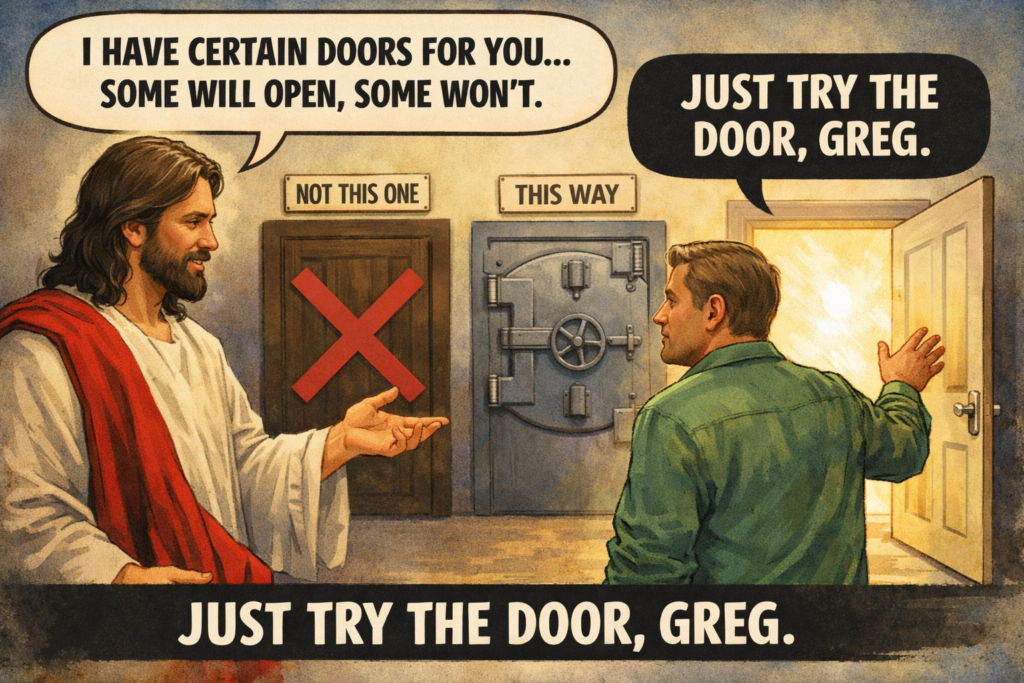
GREG IS EXPERIMENTING WITH DOORS….
Discernment Can this relationship deepen? How much deeper can it go? In what ways? Is it just for me, or does it extend to others as well? Is this as good as it gets—or does Jesus have something more in store?
Action (I try something, the door)
Observation (you notice what actually happens)
Jesus invites me to rest—but it is an active rest: “Look, Greg. Watch. Listen. Learn.” There is so much He wants me to notice, to receive, to awaken to—far more than He wants me anxiously doing. So often, I assume He needs my effort, my striving, my output, but again and again His invitation is simpler, quieter, deeper: PAY ATTENTION, SON.
When the story is finally told, our contribution may resemble the Hebrews at the Red Sea—did they participate? Yes. Did they do the parting? Not really. Perhaps we help a little more than that—but not much more. “…and the labor which they had to perform was to look” (1 Nephi 17:41).
So we look. We look to Christ—and in looking, we begin to think of Him, speak of Him, rejoice in Him: “And we talk of Christ, we rejoice in Christ, we preach of Christ, we prophesy of Christ… that our children may know to what source they may look” (2 Nephi 25:26). We are lookers.
Human beings are, by nature, worshippers (lookers)—creatures of attention. We become what we consistently look at. What we fix our gaze upon begins, over time, to enter us… shape us… even possess us. “…that same spirit… will have power to possess your body…” (Alma 34:34). For good—or for ill. So the question is not whether we will look, but where—not whether we will be formed, but by what.
And Christ’s invitation remains: “Greg, Rest.”…. “Just (mostly) Look. Just (mostly) Watch. Just (mostly) Listen. Just (mostly) Learn.”
And, “if I want you to do anything….well, you’ll know…” (#HearHim)
And, ironically, how I best hear Jesus…. is doing something with Him 🙂 …. lol… next door. Run with sizzors. Really, Jesus? Ok.