The One-Page Saint
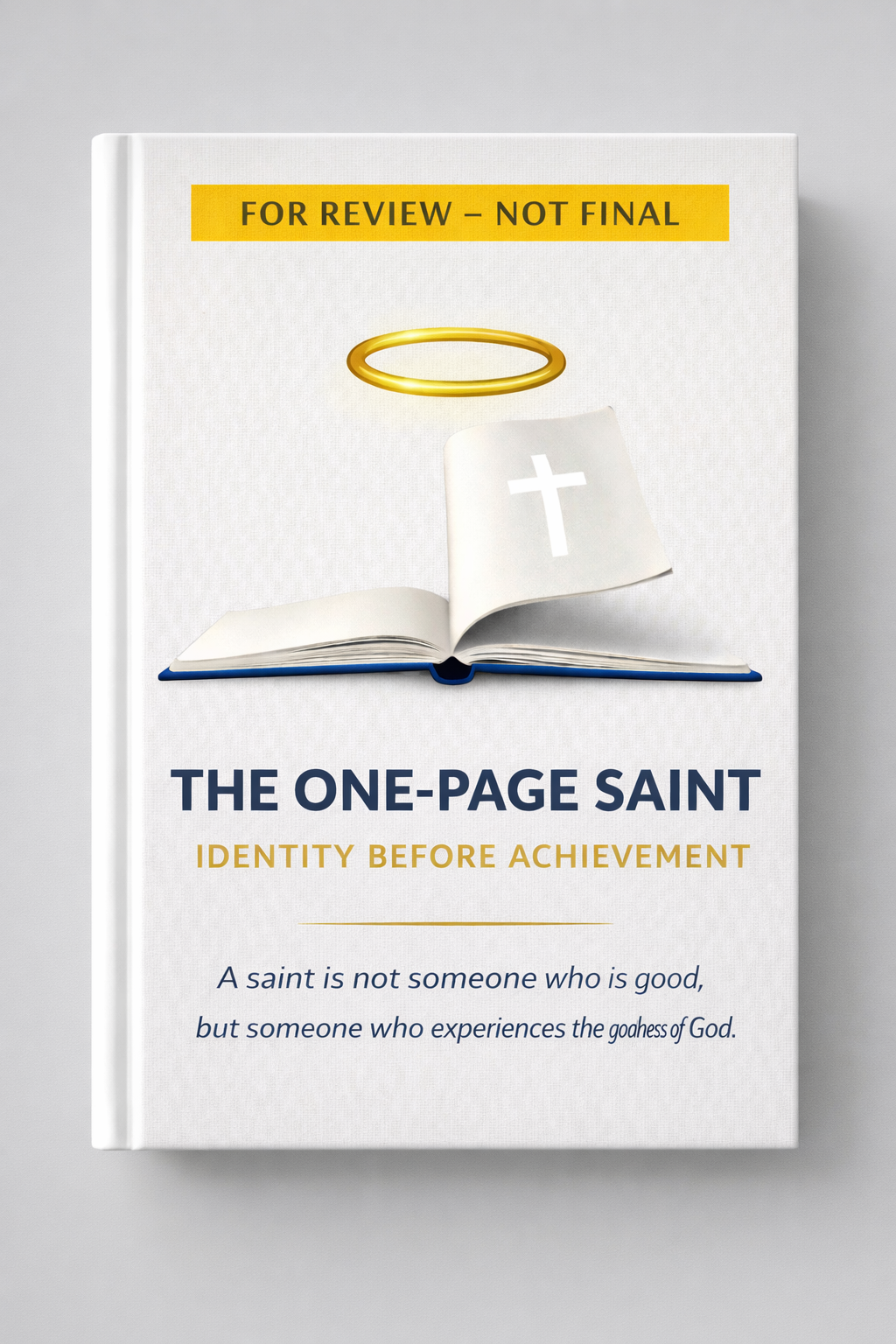
*This book was published as part of the day-long celebration of my bother Paul’s birthday, April 18, 2026, in the Jesus-Greg WORLD in the JesusVerse (not the Metaverse).
Forward
“A saint is not someone who is good,
but someone who experiences the goodness of God.” – Jesus?
I am a Saint. A latter-day one.
My Saint assignment includes introducing the world to Jesus WORLD building (a virtual and physical manifestation/representation of everything that makes up a person’s reality). A key feature of building a “Jesus WORLD” is the building of (and visiting) “Jesus Altars”.
The Jalane Altar (spoken of below) is an example. In the Jalane Altar you will find this book. The one you are reading right now.
==============
THIS BOOK IS A PORTKEY
I am treating this two-part thought piece as a “one-page book”—both literally and symbolically.
I will print it as a single physical page and place it by my bed. This page will function as a “portkey” (in the sense of Portkey): a small, ordinary object that transports me—mentally and spiritually—to a specific place.
That place is the library at Northwest College (formerly NWCC) in Powell, Wyoming.
(The place on earth where this book spiritually/imaginatively resides).
When I travel to this library space, I will do so to be with (to “visit”) Jesus—not abstractly, but as encountered through memory and relationship, in the spirit of Gospel of Matthew 25:38–40. In particular, He will be present in the form of my older sister Jalane, with whom I studied and did homework in that library during high school.
THE JESUS-JALANE ALTAR
This remembered library will function as (part of) a Memory Palace (or Memory Temple)—a structured inner space where I intentionally place and revisit ideas. Like an altar in My Jesus–Greg WORLD, it becomes a sacred repository.
Within this mental “library,” I will store:
// insights
// writings
// recollections
// principles // —especially those connected (even loosely) to the themes of the one-page book.
In this way, the one-page book is not just something I read. It is something I enter—a doorway into memory, meaning, and ongoing dialogue with Jesus.
(Thus, this one-page book leads to other books, movies, maps, notes, in the NWCC library space).
This is a small book.
That is not an apology. It is the point.
We are used to thinking that weighty ideas require length—that meaning expands with page count, that authority grows with volume. But this little work pushes in the opposite direction. It suggests that sometimes a single page, if taken seriously, can do more than a shelf of unread books.
What follows began as an observation about language—specifically, how two Christian traditions use the word “saint” in very different ways. In one, the term is given broadly and early, as a marker of belonging. In the other, it is reserved, formal, and bestowed only after a life has been carefully examined and recognized as exemplary.
At first glance, this looks like a question of difficulty: easy versus hard, common versus rare. But as the pages unfold, it becomes clear that something deeper is at work. These are not simply different standards applied to the same category. They are different strategies for shaping human identity and behavior.
One approach says: Become this, and then you may be called it.
The other says: You are called this—now live into it.
From that difference flows everything else: how people see themselves, how they participate, how communities form, and how ideals are either distributed or concentrated.
But this book is not only meant to be read. It is meant to be used.
By calling it a “one-page book,” the author is doing something deliberate—collapsing the distance between idea and practice. This is not a text to analyze once and shelve. It is something to return to, to sit with, to carry. In the author’s own framework, it becomes a kind of doorway—a fixed point that opens into memory, relationship, and reflection.
That may seem unusual. But it fits the argument of the book itself.
If identity can be given early—if a name can shape a life—then perhaps a small text, engaged deeply and repeatedly, can shape thought in ways a larger one cannot. A single page can be enough, if it is entered rather than merely read.
So this is an invitation.
Not to agree. Not even necessarily to adopt the framework. But to consider the possibility that the labels we use—and the moment we choose to apply them—quietly determine more than we think.
And that sometimes, one page is enough to begin.
Part 1
There’s a quiet but powerful difference hidden in how communities use the same word. Few examples make this clearer than the term “saint,” which carries very different meanings in The Church of Jesus Christ of Latter-day Saints and the Catholic Church. At first glance, it can feel like a difference in difficulty—as if one path is simply easier than the other. But that framing misses something deeper. What’s really at stake is not effort, but category: who the label is for, and what it’s meant to do.
A helpful way to approach this is through the analogy of authorship.
At first pass, the comparison seems straightforward:
>>> LDS “saint” ≈ author of a one-page book
>>> Catholic “Saint” ≈ author of a 300-page book
This captures an intuitive truth. In one case, the label is broadly applied—like calling anyone who has written anything an “author.” In the other, the label is reserved—more like granting the title only to those whose work has been substantial, scrutinized, and widely recognized.
But the analogy, as stated, risks distorting the picture. It suggests a difference of degree within the same category—as if both groups are measuring the same thing, just with different thresholds. That framing can unintentionally imply that one kind of “saint” is simply doing less meaningful work than the other.
That’s not quite right.
A more precise version shifts the focus from output to status and function:
In the LDS sense, “author” is someone who is actively writing—committed to the craft, engaged in the process, part of the community of writers.
In the Catholic sense, “Author” is someone whose work has been published, examined, and formally recognized as exemplary.
Now the distinction becomes clearer. This isn’t about one page versus 300 pages. It’s about:
// membership vs. recognition
// identity vs. certification
// participation vs. canonization
Push the analogy a bit further, and it sharpens even more:
>>> LDS “saint” resembles a student enrolled in a writing program—someone who has stepped into an identity and is expected to grow into it.
>>> Catholic “Saint” resembles a Pulitzer Prize winner—someone whose life has been judged, after the fact, as a model of excellence.
Same word family. Entirely different function.
And that difference in function has consequences—especially when it comes to participation.
Broad labels tend to invite people in. When a community like the LDS Church calls all its members “saints,” it lowers the barrier to entry. You don’t have to earn the title before you belong—you begin with it. That shift matters. It creates identity early, and identity shapes behavior. People often grow into the names they’re given. To call someone a “saint” from the outset is to place an expectation on them, not as a distant ideal, but as a present reality.
It also signals something subtle but important: this is about belonging, not ranking. The label doesn’t separate the exceptional from the ordinary; it gathers the community under a shared aspiration. That tends to reduce intimidation. If sainthood is only for the rare few, most people will never seriously imagine themselves in its orbit. But if sainthood is the starting point, participation becomes natural.
The Catholic model moves in the opposite direction. By reserving the title of “Saint” for those who meet an extraordinarily high bar, it concentrates prestige. The word carries weight precisely because it is rare. These saints become luminous figures—examples to admire, study, and emulate.
But that strength comes with a tradeoff. The higher the bar, the fewer people will see themselves as plausible candidates. The label inspires, but from a distance. It is aspirational rather than participatory.
What emerges, then, are two distinct strategies for shaping human behavior:
>>> Broad labeling: “Come be this with us.”
This approach maximizes inclusion and engagement. It builds identity first and trusts that behavior will follow.
>>> Selective labeling: “Rise to become this.”
This approach maximizes distinction and clarity of excellence. It sets a high ideal and preserves its meaning through scarcity.
Neither approach is inherently superior. Each optimizes for something different. One leans toward community and participation; the other toward recognition and exemplarity.
And perhaps that’s the deeper insight behind the analogy. Words don’t just describe reality—they organize it. Whether you hand someone a title at the beginning or at the end changes not only how many people wear it, but how they understand themselves while they’re trying.
// ======== // PART 2 // ======== // If Part I is about how labels function, Part II is about how one particular tradition has leaned decisively into one side of that spectrum—and done so quite intentionally. // From its beginnings under Joseph Smith, the movement that became The Church of Jesus Christ of Latter-day Saints developed a noticeable pattern: titles are given early, broadly, and with expectation. They are not primarily rewards for arrival; they are invitations to become. // Seen through the “author” analogy, this is a tradition that consistently hands you the pen before the manuscript is written. // Consider how quickly identity is conferred. A baptized member is immediately called a “saint.” Young men, often in their teens, are ordained and addressed as “deacon,” “teacher,” “priest,” and eventually “elder.” These are not symbolic placeholders; they are functional titles that imply responsibility, authority, and a path forward. Even temple language—phrases like becoming “kings and queens” in a sacred, covenantal sense—extends this pattern into the most elevated theological space. The structure is remarkably consistent: name the person as what they are meant to grow into, not what they have already demonstrably achieved. // In “author” terms, this is not just letting someone write a one-page book. It’s calling them an author because they’ve committed to writing at all—and then surrounding them with a system that assumes they will continue. // This approach carries a distinct kind of psychological and social logic. // First, it collapses the gap between identity and aspiration. Instead of holding up a distant category (“sainthood,” “spiritual authority,” “exaltation”) as something to be reached after a lifetime of proof, it pulls that category into the present tense. You are not merely aiming to become something; you are addressed as if you already belong within it. The expectation is forward-looking: live into the name you’ve been given. // Second, it distributes responsibility widely. When titles are given early, participation becomes the norm rather than the exception. A teenage “teacher” or “elder” isn’t waiting decades to matter; he is already embedded in the functioning of the community. The same is true more broadly—members are not spectators to holiness, but participants in it. // Third, it reflects a theological instinct that runs through early Latter-day Saint thought: that human beings are inherently developmental, capable of growth into divine likeness. In that sense, titles are less like medals and more like promissory notes—statements about what a person is expected, and empowered, to become. // This is where the contrast with traditions like the Catholic Church becomes especially sharp. Catholic titles—particularly “Saint”—are retrospective. They look back over a life, evaluate it, and, after rigorous scrutiny, declare it exemplary. The LDS pattern, by contrast, is prospective. It looks at a person near the beginning and says, in effect, this is the trajectory you are now on—act accordingly. // Returning to the analogy, we might say: // The Catholic model tends to say: Show us the finished manuscript, and we may call you an Author. // The LDS model tends to say: You’ve enrolled in the craft; you are an author now—keep writing. // That difference matters because it shapes not just recognition, but behavior over time. // A system that waits to bestow titles until after achievement preserves clarity and prestige. But a system that front-loads identity does something else: it creates momentum. It pulls people into roles, responsibilities, and self-understandings earlier than they might otherwise claim for themselves. // Of course, this approach isn’t without tension. When titles are given broadly, their meaning can stretch. Not every “author” will write well, and not every “saint” will live up to the name in any given moment. The risk is dilution—if everyone holds the title, it can lose its sharpness as a marker of distinction. // But that tradeoff appears, at least historically, to be accepted. The priority is not to guard the title by limiting access, but to activate the individual by granting it. // Seen this way, the pattern that begins with Joseph Smith isn’t accidental. It’s a coherent strategy: build a community where identity is granted early, participation is expected immediately, and growth is assumed to follow. In author terms, it’s a tradition that would rather have a room full of people each writing imperfect one-page drafts than a silent room waiting for a few perfect manuscripts to emerge.
Part 2
((If Part I is about how labels function, Part II is about how one particular tradition has leaned decisively into one side of that spectrum—and done so quite intentionally.))
From its beginnings under Joseph Smith, the movement that became The Church of Jesus Christ of Latter-day Saints developed a noticeable pattern: titles are given early, broadly, and with expectation. They are not primarily rewards for arrival; they are invitations to become.
Seen through the “author” analogy, this is a tradition that consistently hands you the pen before the manuscript is written.
Consider how quickly identity is conferred. A baptized member is immediately called a “saint.” Young men, often in their teens, are ordained and addressed as “deacon,” “teacher,” “priest,” and eventually “elder.” These are not symbolic placeholders; they are functional titles that imply responsibility, authority, and a path forward. Even temple language—phrases like becoming “kings and queens” in a sacred, covenantal sense—extends this pattern into the most elevated theological space. The structure is remarkably consistent: name the person as what they are meant to grow into, not what they have already demonstrably achieved.
In “author” terms, this is not just letting someone write a one-page book. It’s calling them an author because they’ve committed to writing at all—and then surrounding them with a system that assumes they will continue.
This approach carries a distinct kind of psychological and social logic.
First, it collapses the gap between identity and aspiration. Instead of holding up a distant category (“sainthood,” “spiritual authority,” “exaltation”) as something to be reached after a lifetime of proof, it pulls that category into the present tense. You are not merely aiming to become something; you are addressed as if you already belong within it. The expectation is forward-looking: live into the name you’ve been given.
Second, it distributes responsibility widely. When titles are given early, participation becomes the norm rather than the exception. A teenage “teacher” or “elder” isn’t waiting decades to matter; he is already embedded in the functioning of the community. The same is true more broadly—members are not spectators to holiness, but participants in it.
Third, it reflects a theological instinct that runs through early Latter-day Saint thought: that human beings are inherently developmental, capable of growth into divine likeness. In that sense, titles are less like medals and more like promissory notes—statements about what a person is expected, and empowered, to become.
This is where the contrast with traditions like the Catholic Church becomes especially sharp. Catholic titles—particularly “Saint”—are retrospective. They look back over a life, evaluate it, and, after rigorous scrutiny, declare it exemplary. The LDS pattern, by contrast, is prospective. It looks at a person near the beginning and says, in effect, this is the trajectory you are now on—act accordingly.
Returning to the analogy, we might say:
>>> The Catholic model tends to say: Show us the finished manuscript, and we may call you an Author.
>>> The LDS model tends to say: You’ve enrolled in the craft; you are an author now—keep writing.
That difference matters because it shapes not just recognition, but behavior over time.
A system that waits to bestow titles until after achievement preserves clarity and prestige. But a system that front-loads identity does something else: it creates momentum. It pulls people into roles, responsibilities, and self-understandings earlier than they might otherwise claim for themselves.
Of course, this approach isn’t without tension. When titles are given broadly, their meaning can stretch. Not every “author” will write well, and not every “saint” will live up to the name in any given moment. The risk is dilution—if everyone holds the title, it can lose its sharpness as a marker of distinction.
But that tradeoff appears, at least historically, to be accepted. The priority is not to guard the title by limiting access, but to activate the individual by granting it.
Seen this way, the pattern that begins with Joseph Smith isn’t accidental. It’s a coherent strategy: build a community where identity is granted early, participation is expected immediately, and growth is assumed to follow. In author terms, it’s a tradition that would rather have a room full of people each writing imperfect one-page drafts than a silent room waiting for a few perfect manuscripts to emerge.
Paragraph….